Warehouse safety is evolving fast and so are the tools we use to protect workers. Forklift-mounted cameras and pedestrian awareness system promise better visibility for operators, using AI and on-board screens to detect pedestrians near the truck. It’s a step forward, no doubt. But is it enough?
At Collision Awareness, we believe safety shouldn’t ride solely on the forklift. Our motion detection systems monitor intersections and traffic zones independently, providing area-based alerts that notify everyone approaching the intersection, not just the operator, when a potential collision is about to occur.
Let’s Compare: Forklift-Mounted Pedestrian Cameras vs. Fixed-Area Detection
Feature Pedestrian Awareness Camera
Detection Location Mounted to forklift (limited field of view)
Who Gets Alerted? Forklift operator only
Traffic Coverage Works only when forklift is present
Focus Detects pedestrians near forklift
Installation Requires integration with forklift system
Scalability Per forklift
Feature Collision Awareness Product
Detection Location Overhead, rack, and wall mounted
Who Gets Alerted? All traffic in the zone (e.g., pedestrians, forklifts)
Traffic Coverage Constant coverage, even when forklifts are absent
Focus Detects all movement entering sensor’s view
Installation Plug-and-play, no integration required
Scalability Per intersection/zone (protects entire floor layout)
The Bigger Picture: Zone Awareness vs. Operator Assistance
Pedestrian Awareness cameras help an operator see more. Our systems help everyone be seen.
Collision Awareness units create high-visibility zones that actively detect motion from multiple directions and trigger flashing LED alerts (and optional audible alarms) when cross-traffic is detected. These alerts act as a shared signal, creating a pause moment for all traffic types — forklifts, pallet jacks, maintenance carts, and pedestrians alike.
Why the Difference to Pedestrian Cameras Matters
Not every near miss or accident stem from operator error. Sometimes it’s a blind corner. Or a fast-moving cart. Or a pedestrian cutting across a path without realizing a forklift is reversing. That’s why relying on driver-only tech has limits.
Imagine this: A forklift exits a narrow aisle just as a maintenance worker pushes a cart through a perpendicular walkway. The forklift operator is looking left, but a pedestrian with a cart is coming from the right. Even with a camera, the camera might not seem them in time as the blind corner is obstructing the camera’s view. But a Collision Awareness system mounted overhead or to the rack detects both, flashes warning lights, and gives each party the chance to stop before a collision occurs.
Collision Awareness adds a layer of protection across the floor, even in areas where no forklift is present and even when operators are focused elsewhere.
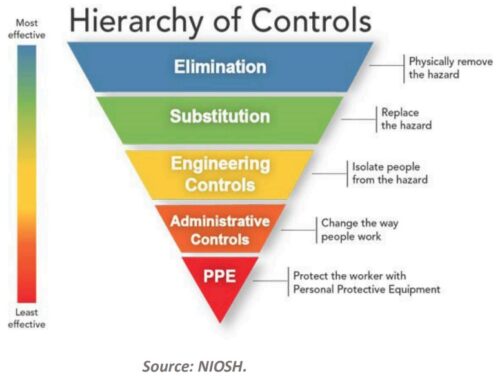
Collision Awareness systems are aligned with OSHA’s Hierarchy of Controls, which prioritizes engineering controls over administrative measures like signage or training. By providing visual and audible alerts that help workers recognize and respond to hazards in real time, our systems function as engineered safety enhancements, directly addressing potential risks before they become incidents. This approach is fully in line with OSHA’s recommendation to implement physical, technology-based interventions wherever possible to reduce the likelihood of workplace injuries.